
.png)
Recently, the third Nanjing Brine Forum (2025), hosted by Jiuwu Hi-Tech, was successfully convened in Nanjing. As a premier industry event in the brine treatment sector, this forum brought together over 200 authoritative experts and key representatives from chlor-alkali production enterprises, salt manufacturing companies, environmental design institutes, research institutions, and industry associations across the country. Together, they explored pathways for technological breakthroughs and new directions for sustainable development in the brine treatment industry.
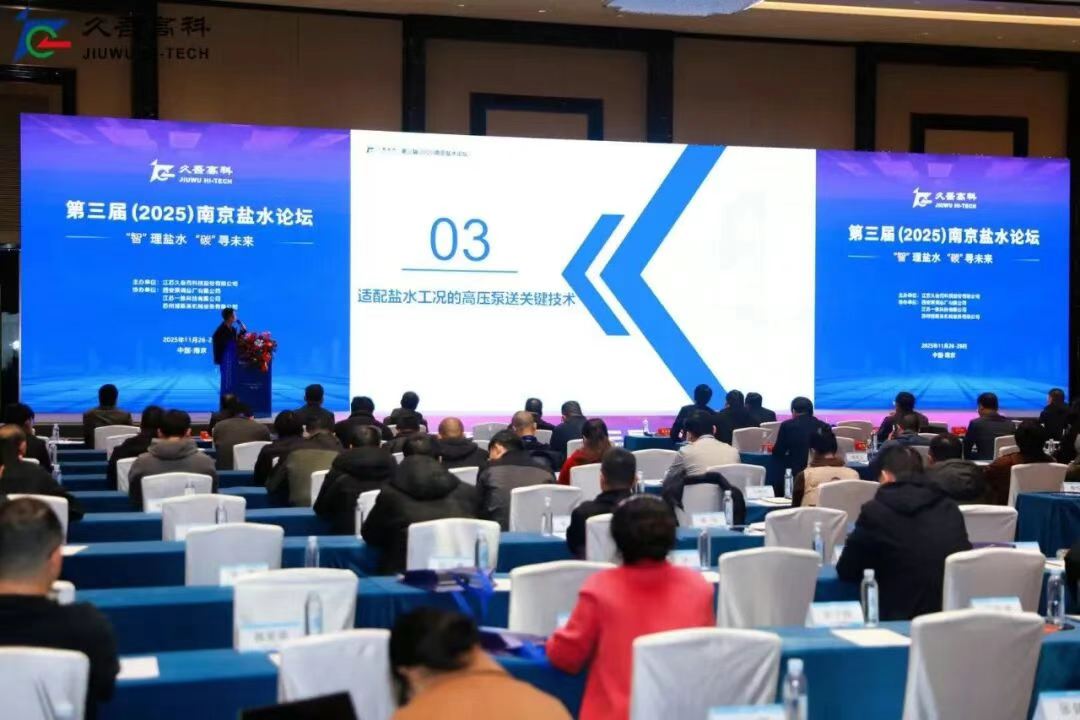
During the keynote session, multiple industry experts took the stage to deliver specialized presentations, offering in-depth analyses of industry development trends and contributing forward-looking insights as well as professional assessments. Leveraging their profound industry expertise and cutting-edge research capabilities, three technical experts from Jiuwu Hi-Tech focused on three core areas—membrane material innovation, application scenario optimization, and integrated solutions—and systematically shared substantial achievements in customized technological breakthroughs aimed at addressing critical industry challenges. The three presentations precisely targeted the core demands of the industry, combining technical depth with practical value, and sparked extensive resonance and lively discussions among the attending guests.
01 《Innovative Applications of New Membrane Materials and Processes in Brine Filtration》
Wenbo Peng, Deputy General Manager of Jiuwu Hi-Tech, introduced the topic from five key perspectives: industry background, new membrane materials and equipment, analysis of raw salt characteristics, and applied research on new membrane materials and processes.
Existing Challenges
● As foundational raw material industries, the chlor-alkali and salt production sectors are at a critical stage of transformation, facing multiple developmental bottlenecks:
● Chlor-Alkali Industry:
Product structure is relatively homogeneous, with downstream applications concentrated in traditional chemical sectors experiencing overcapacity. Supply of high-value-added and high-end products remains insufficient.
Comprehensive utilization of by-products is challenging. Efficient pathways for hydrogen resource utilization are not yet mature, and the high-efficiency, high-value utilization of liquid chlorine has become a long-term bottleneck hindering industry upgrading.
● Salt Production Industry:
Severe product homogenization exists, with minimal differentiation in the quality and functionality of edible salt products, leading to weak market competitiveness.
Development of high-end products lags. In profitable segments such as premium specialty salts and daily chemical salts, most enterprises are small in scale and lack technical strength, making it difficult to achieve large-scale supply.
Response Strategies
● Developing new membrane materials and processes suitable for brine filtration has become the key to overcoming current challenges:
● Focus on the R&D of novel membrane materials by increasing investment in innovation of polymeric membranes, while continuously optimizing the performance of inorganic membrane materials such as alumina and silicon carbide to enhance separation accuracy and environmental adaptability.
● Improve the hydrophilicity and anti-fouling properties of membrane materials through surface modification technologies, coupled with structural optimization designs to reduce membrane channel clogging. These dual measures work synergistically to enhance both water production efficiency and contaminant retention capacity of membrane modules.
● Based on precise analysis of raw salt characteristics, promote the practical, scenario-specific application of new membrane materials and processes. This will enable more efficient, greener, and lower-cost brine treatment processes, providing technical support for structural reforms on the supply side of the industry.
02 《Application and Optimization of Brine Purification and Nanofiltration Denitrification Processes》
Xiaolin Zhang, Sales Manager of the Chemical Division, introduced the topic from four key aspects: the development of brine purification processes, an overview of brine treatment technologies, and the optimization of inorganic membrane-based brine treatment processes.
Existing Issues
● Traditional brine purification processes have increasingly revealed multiple shortcomings in industrial development, struggling to meet modern production demands:
● Early-stage Dorr clarifier + carbon sintered tube process:
The workflow is lengthy and complex, requiring extensive supporting infrastructure, leading to high project investment costs.
Effluent water quality is unstable, with suspended solids (SS) content difficult to control, adversely affecting downstream production efficiency.
● Traditional membrane processes:
Exhibit weak adaptability to raw salt, often encountering operational failures when handling complex feedstocks such as calcium-magnesium inverted salt.
Membrane modules have a relatively short service life, necessitating frequent equipment maintenance and resulting in persistently high operational costs.
● Insufficient anti-fouling capability in some processes:
Substances like magnesium hydroxide in brine are prone to cause membrane fouling, leading to poor operational stability of the equipment and making it difficult to achieve long-term continuous operation.
Response Strategies
● Since 2009, Jiuwu Hi-Tech has been promoting and applying inorganic membrane brine purification technology, continuously optimizing and upgrading it to develop targeted solutions:
● Adopting a short-process design to reduce the need for supporting infrastructure, significantly lowering project investment costs.
● Leveraging core technological strengths to achieve stable and controllable effluent quality, with suspended solids (SS) content ≤0.5 ppm, meeting high-end production standards.
● Enhancing the durability of membrane modules, extending their service life to over 5 years, and reducing the frequency of equipment maintenance and operational pressure.
● Based on raw material characteristics, circulation pumps can be selectively used, balancing operational stability with substantial energy savings, reducing brine processing energy consumption to 0.17 kWh/m³.
● The technology can adapt to different salt types based on actual procurement needs of clients, significantly lowering raw salt purchasing costs.
03 《Exploration of Silicon-Aluminum-Strontium Enrichment Solutions in Rock Salt Application Systems》
Li Zhuang, Director of Solution Development Department II at Jiuwu Hi-Tech, introduced the topic by focusing on three key aspects: background analysis, investigation of reagent-based methods for removing silicon, aluminum, and strontium, and process optimization.
Existing Issues
● In rock salt application systems, impurities such as silicon, aluminum, and strontium in brine have become a core industry challenge.
● These impurities pose serious threats to the ion-exchange membrane electrolyzers—the core equipment in the chlor-alkali industry. They can easily cause membrane fouling, performance degradation, and even equipment failure, directly compromising production safety, efficiency, and long-term stability.
● Traditional impurity removal processes face multiple limitations: some solutions lack sufficient technical feasibility for deep purification; others require excessive reagent consumption and high energy input, leading to elevated operational costs; while certain approaches involve high upfront investment, poor compatibility with existing production processes, and significant retrofitting difficulties.
Response Strategies
● Jiuwu Hi-Tech has selected the reagent method as the core impurity removal pathway and developed an optimized process solution:
● Return brine from the electrolyzer is conveyed to the salt dissolution tank for dissolution treatment, ensuring effective raw material pretreatment.
● Aluminum or magnesium salts are added to create conditions for the reaction and precipitation of impurities such as silicon and aluminum.
● Sodium hydroxide is added to precisely adjust the system pH, promoting the formation of precipitates of silicon, magnesium, or aluminum, which are subsequently separated and discharged via sedimentation tank A.
● Sodium carbonate and sodium hydroxide are further added to optimize the pH, facilitating the formation of precipitates from impurities such as calcium, magnesium, and strontium, achieving secondary separation through sedimentation tank B.
The entire process achieves deep impurity removal, effectively preventing damage to ion-exchange membrane electrolyzers from impurities. It also offers advantages such as controllable costs, ease of operation, and strong compatibility with existing production lines, providing customized solutions for enterprises utilizing rock salt.
The in-depth presentations by the three experts from Jiuwu Hi-Tech not only showcased the company’s profound technical expertise and innovative breakthroughs in core areas such as membrane material R&D, brine purification process optimization, and impurity removal but also highlighted its role as an industry leader proactively tackling critical “bottleneck” technologies and driving the green and high-efficiency development of the sector with a strong sense of responsibility and commitment.
Looking ahead, Jiuwu Hi-Tech will continue to delve deeply into innovation in membrane separation technology, guided by market demands and centered on tackling key technical challenges. We will persistently iterate and optimize our products and solutions, deepen collaboration with industry partners, and jointly strive for shared success. Together, we will advance the brine treatment industry toward higher-end, greener, and more sustainable development, contributing more "Jiuwu Wisdom" and "Jiuwu Solutions" to the high-quality growth of China’s foundational chemical industry.

 +86-25-58849045
+86-25-58749295
+86-25-58849045
+86-25-58749295
 jiuwu@jiuwu.com
 No. 9 Park Road, Pukou District, Nanjing City (Sanqiao Factory)



 Call us on:
  Email Us:
  No. 9 Park Road, Pukou District, Nanjing City (Sanqiao Factory)
 English
 한국어
한국어 français
 русский
 Español