

Sulfate can gradually accumulate as brine circulates through a chlor-alkali plant. Managing that accumulation is an important part of maintaining a usable brine loop.
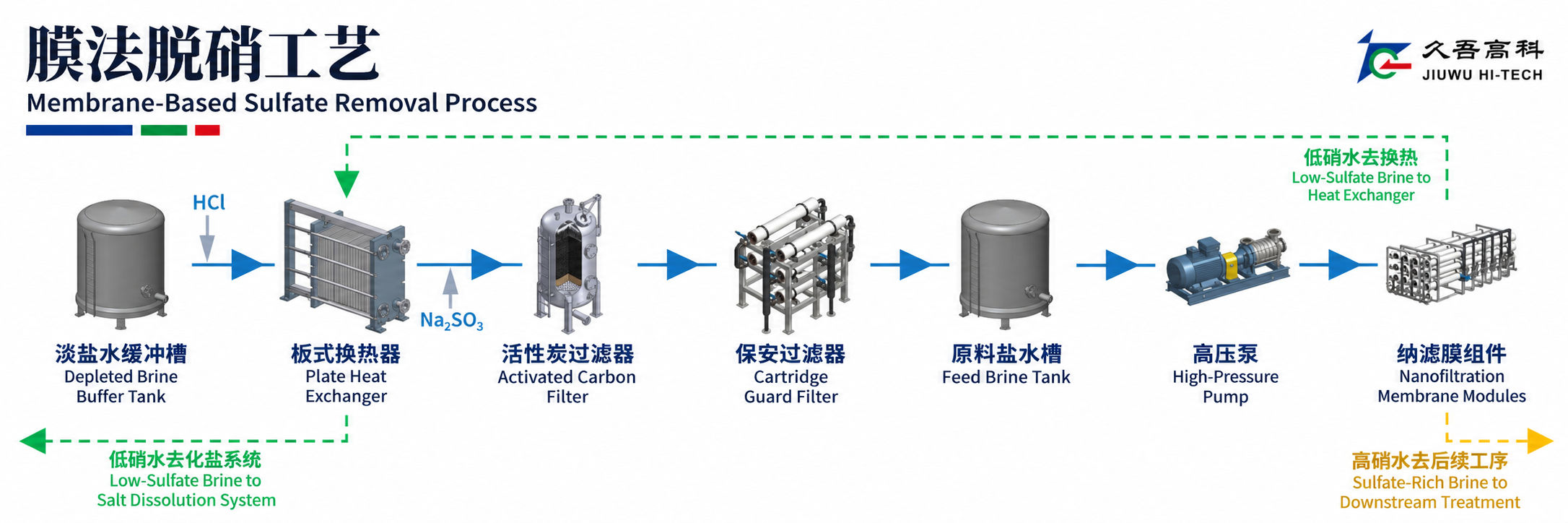
Membrane-based sulfate removal uses nanofiltration to separate the feed into a low-sulfate stream for reuse and a sulfate-rich stream for further treatment.
In this application, the Chinese term “膜法脱硝” refers to sulfate removal—not nitrate removal.
Nanofiltration provides selective separation between sulfate and chloride salts.
Under suitable operating conditions, sulfate is preferentially retained in the concentrate, while a larger proportion of the sodium chloride solution passes into the low-sulfate stream.
The result is two streams with different roles:
Low-sulfate brine returns to the brine preparation system.
Sulfate-rich brine proceeds to downstream treatment.
The separation therefore helps control the sulfate load in the circulating system while retaining brine for reuse.
The nanofiltration membrane is only one part of the installation. Reliable operation also depends on preparing the feed and protecting the membrane.
Jiuwu Hi-Tech’s illustrated process includes a depleted brine buffer tank, a plate heat exchanger, an activated carbon filter, a cartridge guard filter, a feed brine tank, a high-pressure pump, and nanofiltration modules.
Acid and sodium sulfite dosing are also shown in the pretreatment section.
A key protection measure is free chlorine control. The system uses multiple detection points and interlocks to help prevent free chlorine from reaching the nanofiltration membranes.
This makes monitoring and control an essential part of membrane protection, alongside the pretreatment equipment itself.
Sulfate removal does not eliminate the need for downstream management. It transfers sulfate into a smaller, more concentrated stream.
A plant therefore needs to consider the destination of the sulfate-rich brine when designing the membrane system.
The appropriate treatment route depends on the stream composition and the plant’s existing facilities. Membrane separation and concentrate handling should be planned together.
One practical difference is that membrane-based sulfate removal does not require barium addition.
It therefore avoids generating the barium sulfate waste associated with a barium-based precipitation route.
However, the membrane process still produces a sulfate-rich liquid stream that requires an appropriate treatment or recovery route. Its benefit should be evaluated across the complete process.
Jiuwu Hi-Tech reports experience across 89 chlor-alkali membrane sulfate removal projects.
Reported project results include:
Sulfate concentrations below 1 g/L in the low-sulfate stream.
Sodium sulfate concentrations of approximately 80 g/L in the sulfate-rich stream.
The two figures use different measurement bases: the first refers to sulfate, while the second refers to sodium sulfate. They should not be treated as directly equivalent concentrations.
Actual performance depends on feed composition, operating conditions, and system design.
For a chlor-alkali plant, the central design question is how to combine sulfate separation, membrane protection, brine reuse, and concentrate treatment into a reliable operating system.


 +86-25-58849045
+86-25-58749295
 jiuwu@jiuwu.com
 No. 9 Park Road, Pukou District, Nanjing City (Sanqiao Factory)




 Call us on:
 Email Us:
 No. 9 Park Road, Pukou District, Nanjing City (Sanqiao Factory)

 English
 한국어
 français
 русский
 Español