

Salt losses in a chlor-alkali plant do not occur only in the main production process. Usable sodium chloride can also leave the system with membrane concentrate and salt sludge.
Recovering this salt requires attention to two different tasks: recovering brine from the concentrate and washing residual salt out of the sludge.
An integrated membrane concentration and sludge washing process can address both.
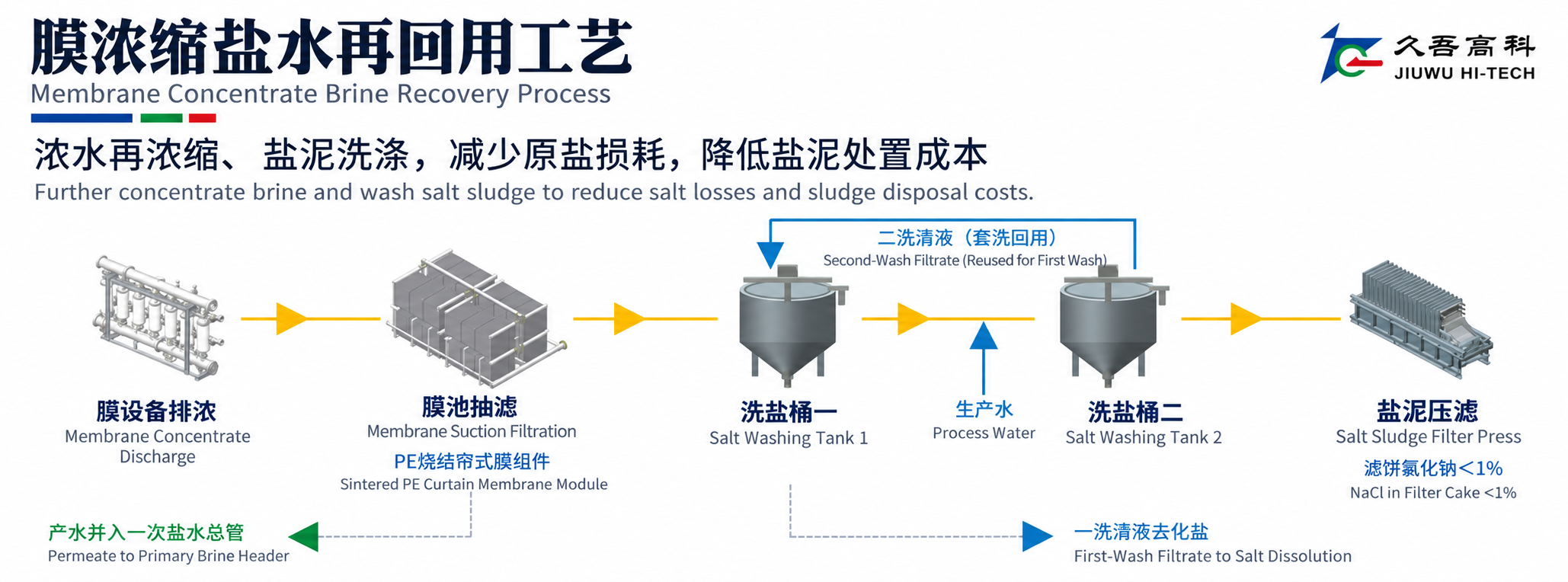
The concentrate discharged from primary brine membrane filtration still contains a substantial amount of liquid. Its solids concentration may be relatively low, so sending the entire stream directly to a filter press increases the hydraulic load on downstream equipment.
Secondary membrane concentration separates part of this liquid before the sludge reaches the washing and dewatering stages.
In Jiuwu Hi-Tech’s process, the available discharge pressure from the ceramic membrane system drives filtration through a sintered polyethylene membrane module. This arrangement avoids the need for an additional transfer pump for that particular step.
The recovered filtrate returns to the primary brine header. The thickened slurry then moves to the salt washing stage.
Dewatering removes liquid from sludge, but it does not necessarily remove enough of the dissolved sodium chloride retained within it.
Washing helps recover that residual salt.
The illustrated process uses two washing tanks. Fresh process water enters the second washing stage, while the second-stage filtrate is reused in the first stage. The first-stage filtrate is then directed to salt dissolution.
This countercurrent arrangement allows wash water to be used more effectively: cleaner water contacts the sludge later in the washing sequence, while the salt-bearing wash liquid returns to a useful point in the process.
After washing, the sludge is dewatered in a filter press.
Jiuwu Hi-Tech reports the following results from actual projects:
More than 60% liquid recovery in the secondary concentration step.
Discharge volume reduced to approximately one-half to one-third of the original volume.
Sodium chloride content below 1% in the sludge filter cake.
Approximately 50% lower wash water consumption.
These figures are project-specific. They should be assessed against the feed composition, washing conditions, and measurement basis of an individual plant.
The first step is to establish a salt and water balance around the existing concentrate and sludge handling system.
Useful questions include:
How much recoverable brine currently enters the filter press?
How much sodium chloride leaves with the final sludge cake?
Where can recovered filtrate be returned?
Is sufficient pressure available for secondary membrane filtration?
How much wash water does the current process consume?
The value of this approach comes from connecting recovery with reuse. Separating more liquid is useful when that liquid can return to production, and washing sludge is useful when the recovered salt can re-enter the brine preparation system.
For chlor-alkali plants seeking to reduce raw salt losses, concentrate recovery and sludge washing deserve to be evaluated as one connected process.


 +86-25-58849045
+86-25-58749295
 jiuwu@jiuwu.com
 No. 9 Park Road, Pukou District, Nanjing City (Sanqiao Factory)



 Call us on:
 Email Us:
 No. 9 Park Road, Pukou District, Nanjing City (Sanqiao Factory)

 English
 한국어
 français
 русский
 Español