
.png)
How to strike the perfect balance between high energy density and ultimate safety is a core challenge that battery material suppliers, cell manufacturers, and automotive OEMs worldwide are collectively striving to solve. Recently, Jiuwu Hi-Tech conducted a comparative nail penetration test between semi-solid-state batteries and conventional liquid batteries, based on the national standard GB 31485-2015. Using the most intuitive and rigorous experimental data, the test revealed the real-world safety performance of semi-solid-state batteries under extreme conditions. The results demonstrated that semi-solid-state batteries using Jiuwu's self-developed LATP material showed no combustion or explosion, marking a substantial improvement in safety.
In actual use, batteries may be subjected to various extreme abuse scenarios, including squeezing, collision, overcharging, heating, and puncture by sharp objects. Among all safety tests, the nail penetration test is the most stringent and the one that most closely simulates real-world hazardous conditions.
Its core principle is as follows: a rigid steel needle rapidly pierces through the battery cell, forcibly creating direct contact between the positive and negative electrodes and causing an internal short circuit. This instantly releases a large amount of heat, thereby testing whether the battery will experience fatal hazards such as fire, explosion, or thermal runaway under unavoidable physical damage. Compared to other tests, the nail penetration test is more unpredictable and triggers short circuits more directly, making it the "gold standard" for verifying battery safety limits.
This test strictly followed the GB 31485-2015 "Safety Requirements for Traction Batteries of Electric Vehicles" and was conducted entirely in a standardized laboratory environment. All parameters, procedures, and results are authentic and traceable, with the sole purpose of revealing the true safety performance of batteries under extreme mechanical damage.
To ensure the fairness and comparability of the experimental results, variables were strictly controlled in this comparative test. The only difference between the two battery groups was their separator and electrolyte systems. All other core materials, specifications, and test conditions were kept completely identical, eliminating external factors to the greatest extent possible, so that any safety differences stemmed entirely from the technology systems themselves.
Semi-Solid Battery: No Fire, No Explosion, No Smoke — Casing Intact
Visual Recording Throughout the Test: When a 3mm steel needle penetrated the semi-solid battery at a constant speed of 8mm/s, the battery remained stable throughout the entire process — no fire, no explosion, no smoke emission, and no casing rupture or deformation.
According to professional temperature monitoring equipment, the maximum surface temperature rise of the battery at the moment of nail penetration was less than 40°C. Only slight local heating occurred at the penetration point, and the heat dissipated rapidly, completely failing to trigger a chain thermal runaway reaction. After the test, with the steel needle removed, the battery structure remained intact with no electrolyte leakage. Its safety performance significantly exceeded national standard requirements.
Liquid Battery: Thermal Runaway Spread — Full Safety Hazard
Under identical test conditions, the moment the steel needle made contact and pierced the liquid battery, the battery immediately reacted violently. Flames quickly ignited, accompanied by a violent explosion, and large amounts of thick black smoke erupted. The battery casing rapidly deformed and was burned away.
Temperature data shows that the maximum surface temperature rise of the battery at the moment of nail penetration exceeded 400°C. Within a short period, full-scale thermal runaway was triggered, and the heat rapidly spread throughout the entire cell, ultimately burning it completely. The safety hazards of liquid battery are alarming.
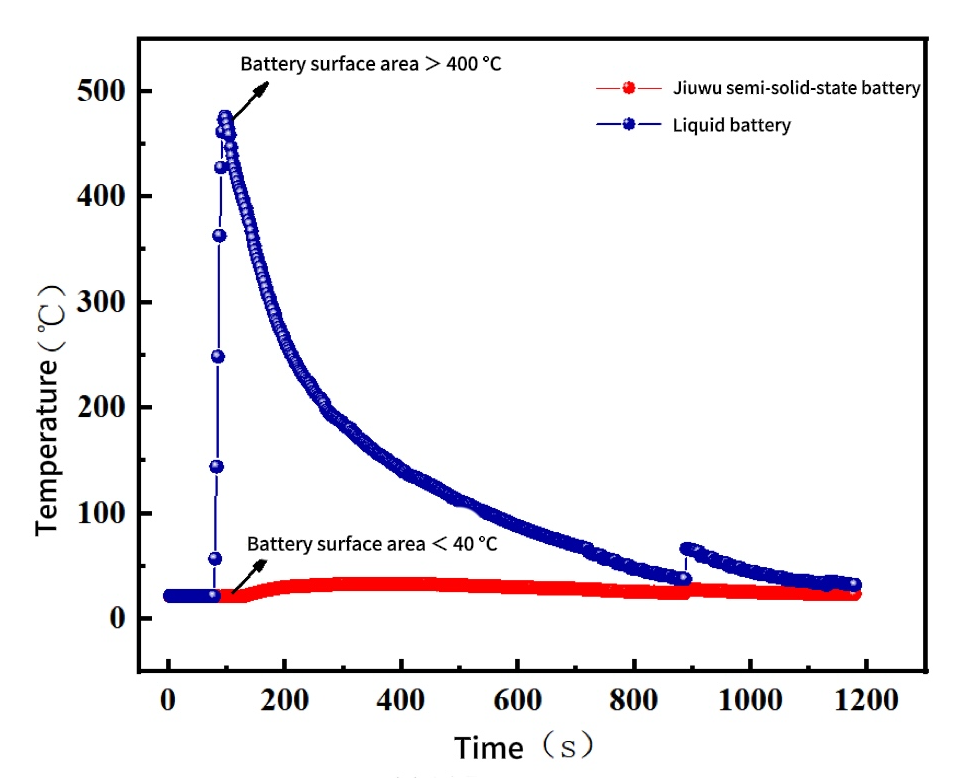
The stark contrast between the two sets of experimental results intuitively confirms the absolute advantage of semi-solid technology in extreme safety scenarios, and also shows the industry a viable path to solving the safety pain points of liquid batteries.
The successful completion of the national standard nail penetration test by this semi-solid-state battery is by no means a mere experimental success. It represents a critical validation of semi-solid electrolyte technology as it moves from the laboratory toward industrialization, and marks a significant breakthrough in the field of lithium battery safety.
This achievement fully demonstrates that semi-solid-state batteries equipped with Jiuwu Hi-Tech's LATP solid-state electrolyte material can fundamentally solve the industry-wide problem of thermal runaway in liquid batteries. Under a high-nickel, high-energy system, they achieve both "high energy density" and "ultimate safety."
For new energy vehicles, this technology enables power batteries to withstand accidental risks such as collisions and punctures, significantly improving the overall safety level of vehicles. For energy storage systems, semi-solid-state batteries can adapt to various scenarios including commercial and industrial energy storage, home energy storage, and grid energy storage, fundamentally reducing safety hazards at energy storage stations. At the same time, this technology can also be extended to portable energy storage, power tools, and other fields, providing a safety foundation for various lithium battery applications.
Looking ahead, Jiuwu Hi-Tech will continue to deepen its R&D efforts in solid-state electrolyte materials, optimize the performance of core products such as LATP-coated separators, and continuously expand their application scenarios across key battery components. By driving the large-scale mass production of semi-solid-state battery technology and collaborating with partners across the upstream and downstream industrial chain, Jiuwu is committed to building a robust safety barrier for new energy through hardcore technology, and to helping the global new energy industry move toward a safer, higher-performance, and more sustainable new era!

 +86-25-58849045
+86-25-58749295
+86-25-58849045
+86-25-58749295
 jiuwu@jiuwu.com
 No. 9 Park Road, Pukou District, Nanjing City (Sanqiao Factory)




 Call us on:
  Email Us:
  No. 9 Park Road, Pukou District, Nanjing City (Sanqiao Factory)
 English
 한국어
한국어 français
 русский
 Español