

Changes in impurity composition, magnesium content, and the calcium-to-magnesium ratio can affect precipitation, filtration, and operating control. A purification system therefore needs to handle more than a single, ideal feed condition.
Ceramic membrane filtration gives chlor-alkali plants a way to separate suspended impurities after chemical treatment, with operating modes that can be adapted to the feed.
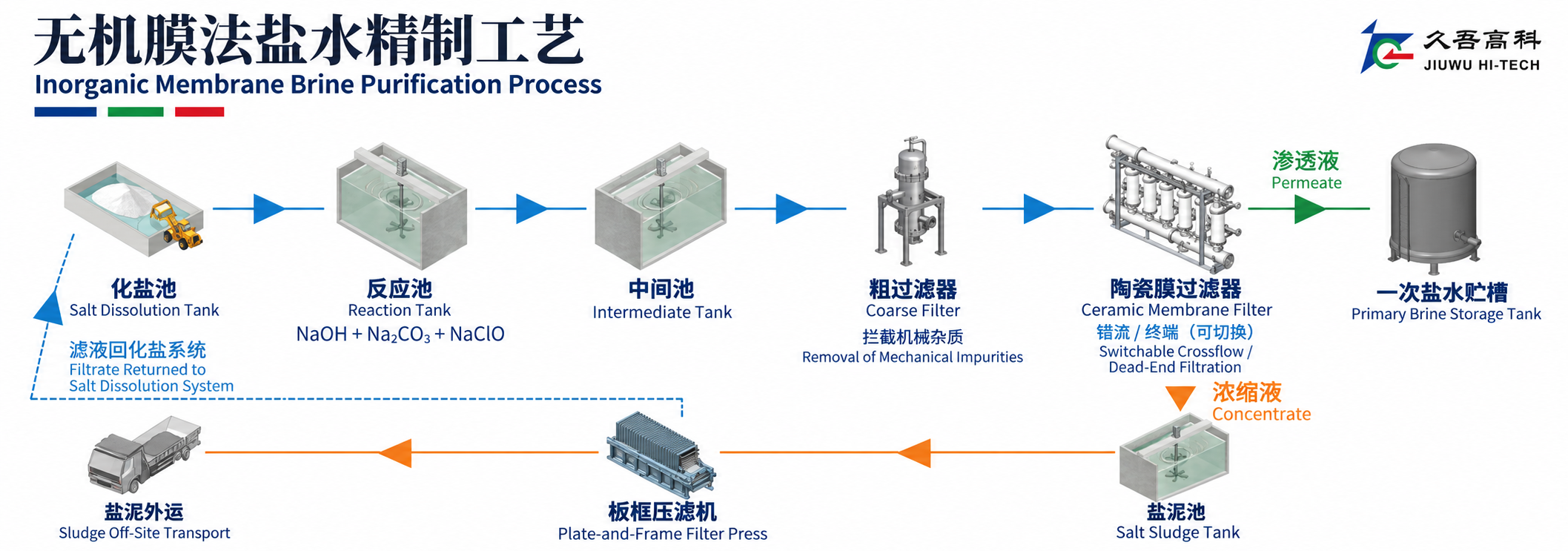
The illustrated process follows this sequence:
Salt dissolution → Chemical reaction → Intermediate tank → Coarse filtration → Ceramic membrane filtration → Primary brine storage.
The reaction stage uses chemicals such as sodium hydroxide and sodium carbonate to support impurity removal. The coarse filter intercepts larger mechanical impurities before the brine reaches the ceramic membrane.
The membrane then separates the treated brine from fine suspended solids.
Permeate flows to primary brine storage, while the concentrate moves to the sludge handling system. Filtrate from sludge dewatering returns to salt dissolution.
The membrane’s role should be understood within the complete purification process.
Ceramic microfiltration separates suspended particles. Calcium and magnesium removal also depends on the associated chemical treatment, which converts relevant dissolved impurities into forms that can be separated.
A reported calcium and magnesium result therefore reflects the performance of the combined purification process, rather than membrane filtration alone.
This distinction matters when comparing technologies or setting performance expectations.
Different impurity loads call for different operating strategies.
Jiuwu Hi-Tech’s process can switch between crossflow and dead-end filtration.
In crossflow operation, brine circulates along the membrane surface. This mode is useful when impurity loads are higher or cake formation is more difficult to manage.
When cleaner refined salt is used, dead-end filtration can reduce the need for continuous recirculation and associated pump operation.
The practical benefit is flexibility: the operating mode can be selected according to the raw salt and the condition of the feed.
The filtration equipment works alongside monitoring, cleaning, and process control.
The described system includes:
Automated acid cleaning.
Online turbidity monitoring.
Abnormal-condition interlocks.
DCS-integrated operation.
These features support the management of filtration and cleaning as feed conditions change.
Jiuwu Hi-Tech reports experience from 185 primary brine purification projects.
According to its project data:
Suspended solids in the treated brine can be controlled below 0.5 ppm.
Total calcium and magnesium can be reduced below 1 ppm with the associated purification process.
These are reported project results, and actual outcomes depend on raw salt characteristics, chemical treatment, and operating conditions.
For plants considering a new installation or a retrofit, the assessment should include feed variability, required brine quality, circulation energy, cleaning requirements, and available space.
Ceramic membrane filtration is most useful when it is designed as part of the full brine purification system—from reaction chemistry to sludge handling—and operated to match the salt the plant actually uses.

 +86-25-58849045
+86-25-58749295
 jiuwu@jiuwu.com
 No. 9 Park Road, Pukou District, Nanjing City (Sanqiao Factory)




 Call us on:
 Email Us:
 No. 9 Park Road, Pukou District, Nanjing City (Sanqiao Factory)

 English
 한국어
 français
 русский
 Español